
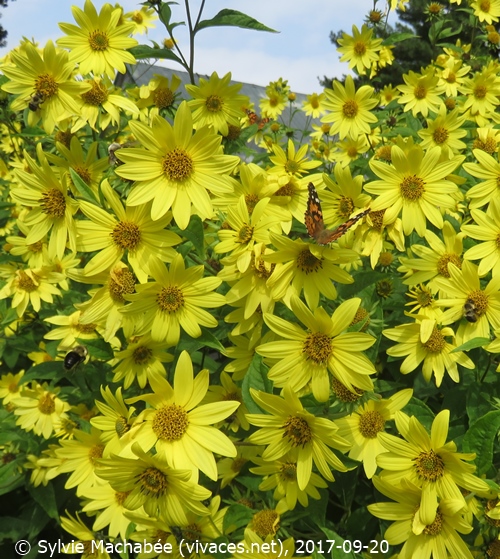
HELIANTHUS x LAETIFLORUS 'Lemon Queen' 
EN BREF :  Sol : frais à modérément sec, soleil, ombre légère, Z4, 150-180cm.
Tournesol vivace sans racines traçantes. Plante spectaculaire aux fleurs jaune citron, repérées de loin par toute une diversité de butineurs.
Plante-hôte du Damier argenté, et plus. Excellent pour des haies ou des écrans rapides. Sol : frais à modérément sec, soleil, ombre légère, Z4, 150-180cm.
Tournesol vivace sans racines traçantes. Plante spectaculaire aux fleurs jaune citron, repérées de loin par toute une diversité de butineurs.
Plante-hôte du Damier argenté, et plus. Excellent pour des haies ou des écrans rapides.IN SHORT: Soil: frais to moderately dry, sun, light shade, Z4, 150-180cm.
Perennial sunflower without tracer roots. Spectacular plant with lemon-yellow flowers, spotted from afar by a variety of foragers. Host plant of the Silvery Checkerspot, and more. Excellent for hedges or fast screens.
|
Noms communs : Tounesol vivace 'Lemon Queen'
Famille : Astéracées
Hybride aux parents originaires du centre de l'Amérique du Nord.
Commentaires de Sylvie - English follows
Ce beau tournesol vivace se reconnait facilement au jaune citron de ses fleurs, une couleur inhabituelle chez les tournesols. Il est issu de deux espèces natives du centre de l'Amérique du Nord, (Helianthus pauciflorus ssp. Subrhomboideus, l'hélianthe rigide et Helianthus tuberosus, le topinambour) qui se croisent spontanément et qui sont naturalisées au Québec. Le topinambour aurait été implanté par les autochtones depuis longtemps, comme ressource alimentaire. Il a fait son chemin jusqu'en Europe où il a été très utile pour sauver les gens de la famine pendant la Seconde guerre mondiale.Ce rejeton des deux espèces, nommé 'Lemon Quen', est une sélection américaine remarquée pour la couleur de ses fleurs, mais aussi pour l'absence des racines traçantes dont sont généralement "équipés" les grands tournsols vivaces, incluant ses parents. Il forme plutôt une touffe qui grossit avec les années et qu'on divisera au besoin.
Il a tout d'une plante vedette. Dans les régions plus au sud, il peut atteindre 2,4 m, mais dans nos régions, c'est plutôt 1,5 à 1,8 m. La tenue peut-être un peu faible à la mi-ombre, mais elle est bonne au soleil, sauf aux grands vents. Dans mes jardins, la floraison commence vers la fin août ou le début septembre. C'est une splendeur qui se voit de loin et qui attire beaucoup de butineurs de toutes sortes qui le repèrent de loin. Sont présents, des abeilles découpeuses de feuilles, des halictidés, des bourdons, des papillons, et bien d'autres.
Il est probablement, comme ses parents et d'autres tournesols, une plante-hôte pour le Damier argenté (Chlosyne nycteis) et le Damier gorgone (Chlosyne gorgone), ainsi que pour le très polyphage papillon Belle-Dame (Vanessa cardui) et probablement pour certains papillons de nuit.
Il convient très bien à la formation de haies ou d'écrans car il est touffu jusqu'à la tête et atteint une bonne hauteur assez tôt en saison. Le défaut des haies de vivaces, contrairement aux haies d'arbustes, est qu'elles démarrent du sol à chaque année et n'atteignent leur hauteur qu'au cours de l'été. L'avantage est que la croissance est plus rapide que chez les arbustes. Ma haie de tournesols 'Lemon Queen' était parfaitement fonctionnelle dès l'année suivant la plantation, à partir de plants provenant de pots de de 3 litres.
Il est réputé stérile, mais j'ai régulièrement des semis, qui sans être nombreux, ne sont pas rares. La production de semences est trop faible pour être une ressource pour les oiseaux.
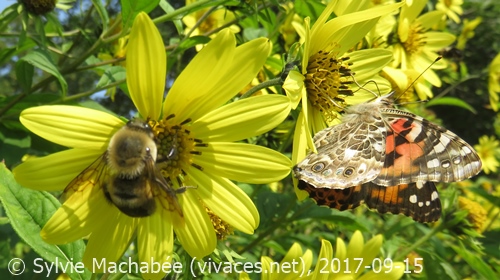
Bourdon et papillon Belle-Dame (Vanessa cardui)
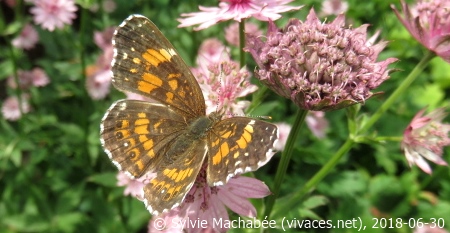
Damier argenté (Chlosyne nycteis)
HELIANTHUS x LAETIFLORUS 'Lemon Queen'
Common Names: Perennial Sunflower 'Lemon Queen'Family: Asteraceae
Hybrid with parents from central North America.
Sylvie's comments
This beautiful perennial sunflower is easily recognizable by the lemon yellow flowers, an unusual color in sunflowers. It comes from two species native to central North America, (Helianthus pauciflorus ssp. Subrhomboideus, the stiff sunflower and Helianthus tuberosus, the Jerusalem artichoke). that cross spontaneously and are naturalized in Quebec. The Jerusalem artichoke is said to have been implanted by the natives a long time ago, as a food resource. It made its way to Europe where it was very useful in saving people from starvation during the Second World War.This offspring of the two species, named 'Lemon Quen', is an American selection noted for the colour of its flowers, but also for the absence of the tracer roots that are usually "equipped" with large perennial sunflowers, including its parents. Instead, it forms a clump that grows over the years and can be divided if necessary. Instead, it forms a clump that grows over the years and is divided as needed.
It has all the makings of a star plant. In more southerly regions, it can grow to 2.4 m, but in our regions, it is more like 1.5 to 1.8 m. It may be a little weak in mid-shade, but it is good in the sun, except in high winds. In my gardens, flowering starts towards the end of August or early September.It is a splendour that attracts many foragers of all kinds who spot it from afar. Leafcutter bees, halictids, bumble bees, butterflies, and many others are present.
It is probably, like its parents and other sunflowers, a host plant for Silvery Checkerspot (Chlosyne nycteis) and the Gorgone Checkerspot (Chlosyne gorgone), as well as for the very polyphagous Painted Lady (Vanessa cardui) and probably for some moths.
It suits very well for the formation of hedges or screens as it is bushy up to the head and reaches a good height early in the season. The disadvantage of perennial hedges, unlike shrub hedges, is that they start from the ground each year and reach their height within a few days.
It is probably, like its parents and other sunflowers, a host plant for Silver Damask (Chlosyne nycteis). and the Damier gorgone (Chlosyne gorgone), as well as for the very polyphagous Belle-Dame butterfly (Vanessa cardui) and probably for some moths.
It is also suitable for the formation of hedges or screens as it is bushy up to the head and reaches a good height early in the season. The disadvantage of perennial hedges, unlike shrub hedges, is that they start from the ground and reach their height during the summer. The advantage is that growth is faster than in shrubs. My hedge of 'Lemon Queen' sunflowers was fully functional the year after planting, from plants grown in 3 litre pots.
It is known to be sterile, but I regularly have seedlings, which although not numerous, are not rare. Seed production is too low to be a resource for the birds.
Les VIVACES de l'Isle
www.vivaces.net